Agricultural Resource Applications
Nantou County Road 139|Recycling Pineapple Agricultural Waste

Nantou County Route 139 is one of Taiwan’s most important pineapple-growing regions.
For generations, local farmers have relied on pineapple cultivation for their livelihoods.
The fruit’s fragrance, flesh, and iconic pineapple cakes have fueled the regional economy and tourism industry.
Yet behind every harvest lies a hidden reality—large quantities of discarded pineapple leaves, stalks, and roots.
After crop rotation, these agricultural residues are often burned in the fields,causing air pollution and placing an additional burden on the land.
For farmers, the challenge extends beyond cultivation itself.
It is also the heavy responsibility of managing agricultural waste.

Agricultural Waste Management
Pineapple cultivation requires replanting every three years. During this process, residual materials such as pineapple stems, leaves, and crowns must be removed from the fields, posing a significant disposal challenge for farmers.
Through the “Agricultural Waste Regeneration Program – Plant Fiber Packaging Material Application Project,” these collected pineapple residues have been successfully transformed into pineapple fiber-based raw materials. These materials have been further developed into agricultural mulch films and fruit protection bags, which can be returned to the farmland after use, completing a sustainable circular cycle.
The Challenge
After pineapple harvesting, large volumes of roots, stems, and leaves remain in the fields. These residues are typically considered unusable and are often disposed of through open burning or burial.
However, these materials are structurally dense, with extensive root systems and strong fibers, making their removal labor-intensive. For small-scale farmers with limited manpower, this becomes a significant operational burden.
Year after year, these “seemingly useless” agricultural residues accumulate in the fields—driving up farming costs while simultaneously creating hidden environmental pressures, including carbon emissions and soil impact.
The Problem
After pineapple harvesting, the remaining roots, stems, and leaves are nearly impossible to reuse.
They occupy valuable farmland space, are coarse and fibrous in structure, and exist in large volumes—
making them one of the most persistent challenges faced by farmers.
These agricultural residues are difficult to handle, transport, and remove. Their presence also disrupts subsequent land preparation and crop rotation processes, often forcing farmers to resort to open burning or burial.
Such practices are not only time-consuming and labor-intensive, but also place additional strain on soil health and air quality.

_edited.jpg)

The Hidden Impact of Conventional Mulch Films
Pineapple farms commonly rely on traditional black plastic mulch films to suppress weeds and retain soil moisture. However, after harvesting, these films often remain entangled with root systems and embedded in the soil, making complete removal extremely difficult.
To reduce labor and disposal costs, small-scale farmers frequently resort to on-site burning. This practice releases toxic emissions, contributes to air pollution, and degrades soil structure—ultimately affecting the growth of subsequent crops. Moreover, residual plastic fragments can accumulate in farmland over time, introducing long-term environmental and food safety risks.
Tunenturn’s Action: Transforming Agricultural Waste into Valuable Resources
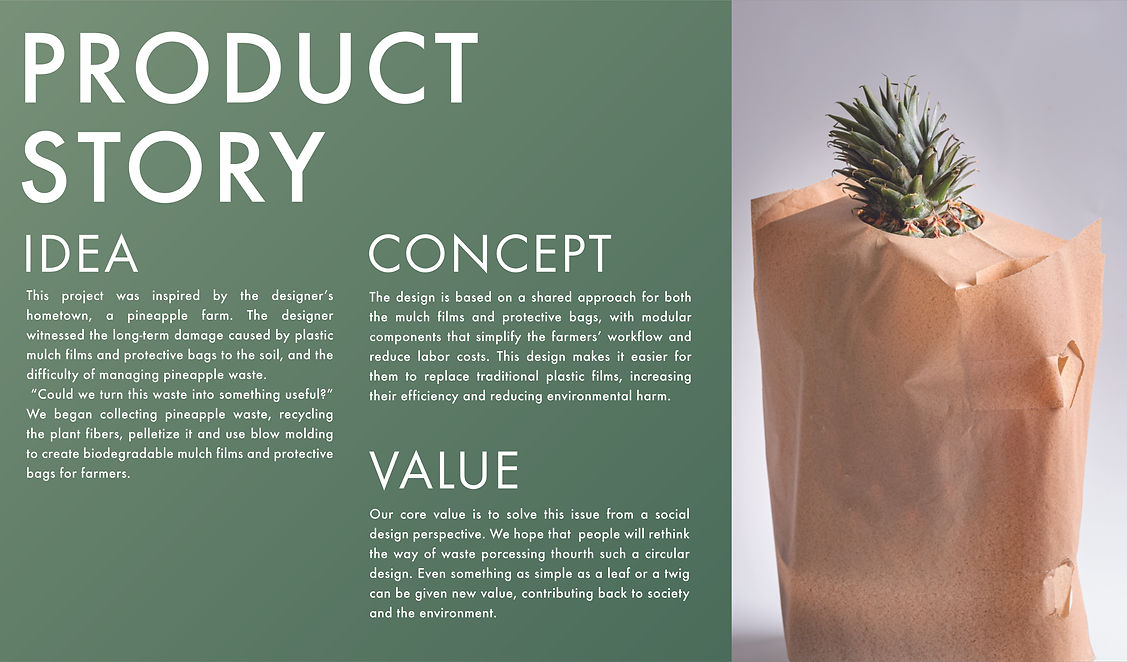
The Tunenturn team engaged directly with pineapple farms and identified that pineapple leaves are rich in natural plant fibers. With proper utilization, these materials can be transformed from agricultural waste into valuable, regenerative resources.


_JPG.jpg)
From pineapple waste to valuable fiber resources.


We developed a localized processing system that includes on-site collection, cleaning, drying, and mechanical pulverization of pineapple residues. By blending these fibers with naturally biodegradable binders, we successfully created a moldable pineapple fiber pellet material, enabling scalable manufacturing applications.
This material has been further applied across a range of agricultural and sustainable products:
-
Biodegradable Agricultural Mulch Films
Designed to replace conventional PE plastic films, these mulch films can be directly tilled back into the soil after use, where they naturally decompose without leaving plastic residues. -
Pineapple Fiber Fruit Protection Bags
Breathable and biodegradable, these bags help reduce fruit damage while minimizing plastic pollution in agricultural practices. -
Sustainable Packaging (Under Development)
Including pineapple fiber envelopes, shopping bags, and product packaging solutions, expanding the application of agricultural waste into circular packaging systems.
✅ Fully biodegradable agricultural mulch film
✅ Fruit thinning & protection bags
✅ Expandable to packaging, seedling tools, and agricultural containers
Advantages
Plastic-free. Naturally decomposes in soil within 3–9 months—no need for incineration or collection.
Returns directly to the land, supporting both crops and farmers through modular design.
Applications
-
Fully Biodegradable Agricultural Mulch Films
-
Fruit Protection Bags for Thinning and Cultivation
-
Expandable Material Applications
Including sustainable packaging, seedling containers, and value-added agricultural products
Key Advantages
-
100% plastic-free material
-
Naturally decomposes in soil within 3–9 months
-
No need for collection, incineration, or disposal logistics
-
Directly returns to the land after use
-
Designed to support both farmers and crops through a nature-positive approach
Modular Design & Application System
Pineapple Fiber Agricultural Mulch Film
Developed as a sustainable alternative to conventional plastic mulch films, providing effective soil temperature regulation and weed suppression.
The modular sizing system allows flexible adaptation to different field conditions and crop layouts.
After use, the film can be directly tilled into the soil, where it decomposes naturally.
Pineapple Fiber Fruit Protection Bags
Breathable, UV-resistant, and pest-protective, suitable for crops such as pineapple, mango, and pomelo.
Designed with modularity for efficient large-scale application and easy on-site replacement.
Modular System Features
All agricultural materials are developed under a system-based design approach, allowing flexible integration of material properties, sizes, and usage scenarios.
This system supports seasonal farming operations and diverse crop management needs, while remaining compatible with existing agricultural tools—significantly lowering adoption barriers.
Environmental & Social Impact
-
Reduces reliance on plastic-based agricultural materials
-
Minimizes soil contamination and air pollution from burning
-
Upcycles agricultural waste into high-value local resources
-
Provides practical, scalable, and environmentally friendly solutions for farming communities
-
Aligns with ESG principles, circular economy frameworks, and green agricultural transformation
Design Philosophy
We believe that design is fundamentally about solving real-world challenges.
This project originates from a deep observation of environmental issues and a profound understanding of local agricultural culture. Through design intervention, we transform “overlooked waste” into products that carry both functional value and emotional connection.
By integrating material innovation, community participation, and local collaboration, we aim to propose a sustainable solution that is closer to the land—and closer to people.
Design is not merely about aesthetics; it is the manifestation of systemic thinking.
A Circular System from Source to Soil
Starting from raw material regeneration, we consider the entire lifecycle—from production processes and usage scenarios to end-of-life decomposition—creating a closed-loop system that returns materials back to nature.
The design of the pineapple fiber agricultural mulch film is rooted in an in-depth understanding of Taiwan’s pineapple farming landscape.
Three Core Principles
1. From Waste to Resource: Circular Agriculture
Transform agricultural residues into high-value farming materials, establishing a closed-loop cycle from farmland back to farmland.
2. Farmer-Centered Design: Reducing Labor & Environmental Burden
Biodegradable and collection-free, the material significantly reduces the need for manual removal while lowering pollution and carbon emissions from burning.
3. Coexistence with the Land: Local Materials × System Thinking
Through system design, we integrate agricultural waste, material engineering, farming practices, and local governance—delivering a solution that balances sustainability, efficiency, and cultural value.
Vision & Impact
We believe that truly meaningful design is not about creating more—but about reinterpreting what already exists.
This pineapple fiber mulch film is not merely a material innovation; it represents a reimagining of the future of agriculture.
By collaborating with local farmers and communities, we are building a localized value chain—from raw material collection to manufacturing and field application—realizing true co-creation at the local level.
More importantly, this initiative aims to inspire broader awareness of sustainability, foster policy dialogue, and promote education—amplifying the social impact of design.
This is not just a product.
It is a design experiment in coexistence with nature.
We hope this approach offers a new perspective—where Eastern ecological wisdom meets contemporary design—within the global transition toward sustainability.